The Real Estate Income Gap: Why Agents "Earn" $70K But Take Home $25K
If you've ever seen a headline about the "average real estate agent salary" and felt like the number didn't match your bank account, you're not imagining things. There's a real, well-documented gap between what agents appear to earn and what they actually keep and understanding that gap is the first step to closing it.
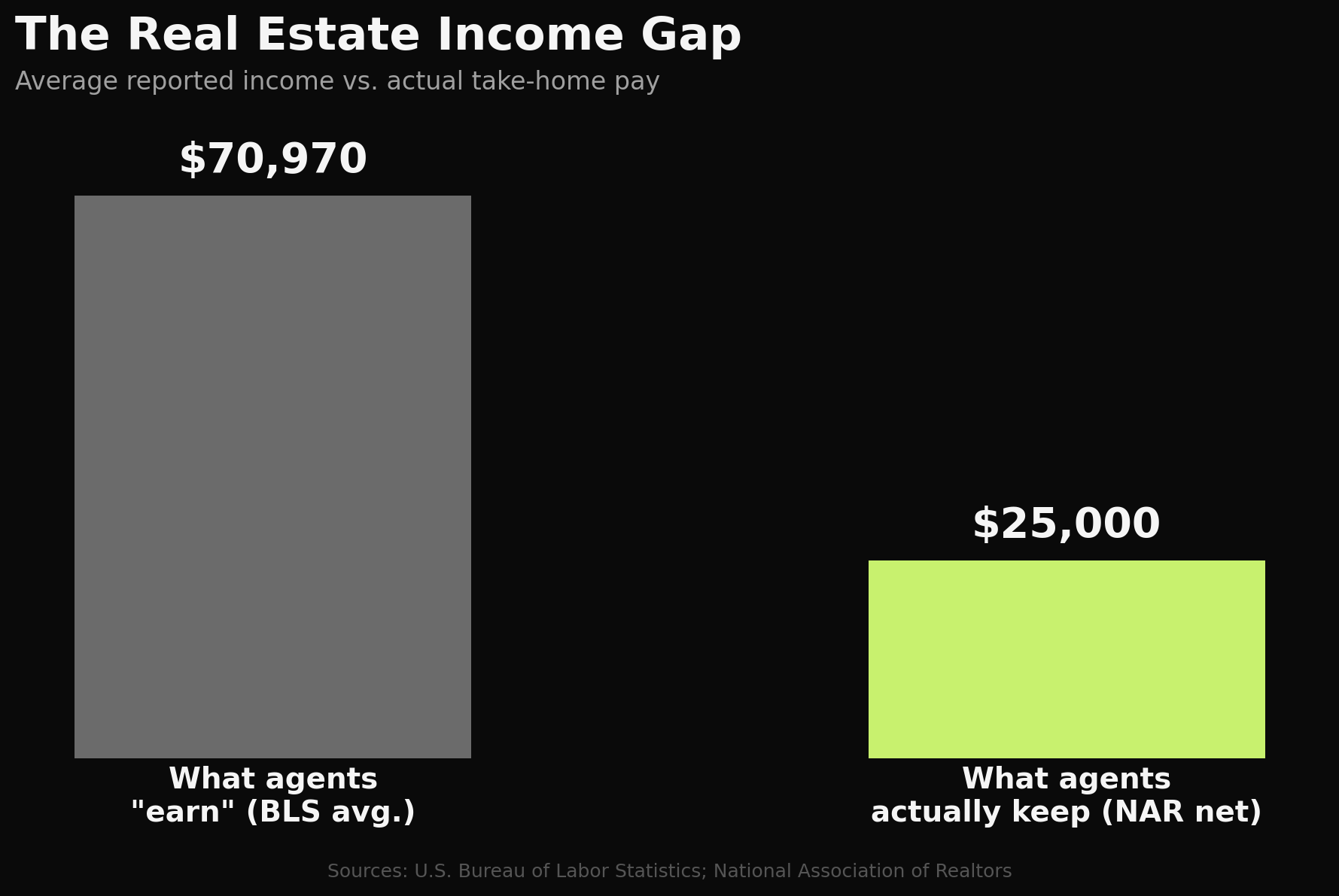
Here's the number that gets quoted everywhere: the U.S. Bureau of Labor Statistics puts average annual real estate agent income at roughly $70,970. Sounds solid. But dig into the National Association of Realtors' own member reporting, and a very different number shows up, a median net income closer to $25,000 once business expenses are factored in, across the full population of licensed agents.
That's not a rounding error. That's a $45,000 gap between the number that gets cited in career-day pamphlets and the number that actually lands in an agent's pocket. If you're new to the industry, or even a few years in and wondering why the math doesn't add up, this is the article that explains why.
Gross Commission Income vs. Net Commission Income: The Real Difference
Every agent has heard the terms GCI and NCI thrown around, but most brokerages don't spend much time explaining why the distance between them matters so much.
Gross Commission Income (GCI) is the total commission generated from a closed transaction before anything is deducted. It's the headline number, the one on the closing statement, the one that gets celebrated in the group chat.
Net Commission Income (NCI) is what's actually left after:
Brokerage split (commonly 30–40% off the top on traditional models)
Team splits, if applicable (often another 50% on team-generated leads)
Marketing and lead generation costs
Transaction and desk fees
Self-employment tax (15.3%, since agents are 1099 contractors, not W-2 employees)
Standard income tax on top of that
By the time all of that clears, a $12,500 GCI check can realistically net out closer to $5,000–$7,000; a 40–56% take-home rate is common, and it can go lower depending on your split structure and expenses.
Where the $70K vs. $25K Gap Actually Comes From
The BLS figure is calculated differently than NAR's net income reporting, and understanding the difference matters:
BLS "Average Income" (~$70,970)NAR Median Net Income (~$25,000)What it measuresGross earnings before most business expensesTake-home after brokerage splits, marketing, and business costsWho's includedFull-time agents with consistent transaction volumeAll licensed agents, including part-time and low-volume agentsSkews towardHigher-producing, established agentsThe full range, including newer agents (2 years or less) who close far fewer deals
The takeaway isn't that one number is "wrong." It's that they're measuring different things, and most agents, especially newer ones are far closer to the second number than the first. If you're comparing your own income to the $70K headline figure and feeling like you're falling short, you're likely comparing yourself to the wrong benchmark.
Why This Gap Matters More in 2026
Two shifts happening right now make this gap more relevant than it's been in years:
1. Buyer agency agreements changed how compensation flows. Since the 2024 NAR settlement took effect on August 17, 2024, buyer-side commission is no longer advertised through the MLS, it's negotiated directly and documented in a written buyer representation agreement. This means agents now have more visibility into their compensation earlier in the relationship, but also more direct negotiation to navigate, which can compress margins for agents who aren't confident negotiating their own fee.
2. Commission splits are more varied than ever. Traditional franchise brokerages still run 60/40 to 70/30 splits. Cloud and virtual brokerages often offer 80/20 or better. Flat-fee/100%-commission models trade a high split for a flat desk fee. The split you're on has a bigger impact on your NCI than almost any other single factor you control, bigger than your commission rate, in most cases.
How to Close the Gap Yourself
Understanding the gap is step one. Closing it comes down to a few concrete levers:
Know your real number. Track NCI, not just GCI, every month. If you only look at gross commission, you're managing the wrong metric.
Audit your split. Run the actual math on what a higher-split brokerage would net you at your current volume, the difference is often larger than agents expect.
Set aside for taxes before you spend. A 25–30% set-aside on every check prevents the tax bill from feeling like a surprise expense that eats into what you thought was "take-home."
Negotiate buyer compensation directly and confidently. The transparency in today's buyer agency agreements is an opportunity, not just a compliance requirement, agents who negotiate well are protecting their NCI at the source.
FAQ
Is $70,970 what most real estate agents actually make? No — that figure reflects gross earnings for agents with consistent, often full-time transaction volume. It doesn't account for brokerage splits, business expenses, or self-employment tax, and it doesn't reflect the full population of licensed agents, many of whom work part-time or are early in their careers.
What's a realistic net income for a new agent? It varies significantly by market and split, but NAR's reporting suggests newer agents (two years or less) often net well below the $25,000 median, particularly in their first year while building a pipeline.
How do I calculate my own net commission income? Start with your GCI, then subtract your brokerage split, any team split, marketing/lead costs, transaction fees, and a 25–30% tax set-aside. What's left is your real NCI — the number to track against your goals, not your gross.
Know Your Real Number
Reading about the gap is one thing. Seeing your own is another.
Grab the free Net Commission Income Calculator — plug in your GCI, your split, and your monthly expenses, and get your real take-home number in under two minutes. No more guessing what you actually netted last month.
→ Calculate My Real Take-Home Pay
Once you know your real number, the next question is usually: how do I close the gap? That's exactly what we teach, including how agents are using their existing database to build income that doesn't disappear the month after closing. Follow along on Instagram for the rest of the playbook.
Sources
This post draws on data from the U.S. Bureau of Labor Statistics — Occupational Employment and Wage Statistics for Real Estate Sales Agents and the National Association of Realtors — Research and Statistics, including reporting on 2024 settlement practice changes effective August 17, 2024. Figures cited reflect the most recently available reporting at time of publication and are subject to change as new data is released.